- EREIT has been raising funds through various
measures, such as the recent SGD 300.0m Equity Fund Raising in April 2023 and
the proposed divestment of non-core assets for an aggregate sum of SGD 337.0m.
- New Economy sectors, such as third-party logistics
(3PL) and e-commerce businesses, are experiencing rapid growth, fuelling demand
for high-spec logistics assets that meet their business and sustainability
requirements.
- EREIT’s portfolio is dominated by assets meeting
these requirements (63.2% by rental income), allowing them to take advantage of
the boom in New Economy industries.
- EREIT’s credit and liquidity profile is also set
to improve after the completion of their proposed divestments, set to be
completed by this year.
- We recommend EREIT 2.600% 04Aug2026 Corp (SGD) for investors looking for a higher-yielding issue amongst its peers.
ESR-LOGOS REIT (“EREIT”) is an industrial REIT listed on the SGX, with a portfolio containing industrial properties across various segments such as: logistics, high-tech, business parks and warehouses. The portfolio contains 81 properties as of 30 June 2023, with 60 located in Singapore, 20 in Australia and 1 in Japan. The carrying value of investment properties in the portfolio totaled to approximately SGD 4.7b as of 30 June 2023. Including the value of properties set for divestment (SGD 361.4m), EREIT has SGD 4.9b assets under management (“AUM”). EREIT also has partial interest in 3 property funds in Australia. Currently, EREIT has a market cap of SGD 2.42b as of 30 June 2023.
The manager of EREIT is ESR-LOGOS Funds Management Limited (the “Manager”) and sponsored by the ESR group (“ESR”). The manager is owned by ESR (99.0%) and Shanghai Summit Pte. Ltd. (1.0%). EREIT was formed through a merger between ESR-REIT and ARA LOGOS Logistics Trust via a trust scheme of arrangement and was completed in 2022, propelling the REIT to become the 5th largest industrial S-REIT.
EREIT completed an equity fund raising on 28 April 2023, to raise gross proceeds of approximately SGD 300.0m. The equity fund raising consisted of a private placement of 454,545,000 new units and a preferential offering of 460,766,519 new units, with each of the components raising about SGD 150.0m. The manager has announced that SGD 293.0m of the gross proceeds from the fund raising will used to fund future potential acquisitions and asset enhancement initiatives (“AEI”) of any existing properties, with the remaining amount of SGD 6.7m to be used for fees and expenses to be incurred in connection with the fund raising.
Financial Highlights
According to its half-year financial results ended 30 June 2023 (“1H23”), net property income increased 37% year-on-year (“YoY”) to SGD 140.8M, mainly driven by full half-year contributions from the former ALOG Trust after the merger and the acquisition of a logistics property in Japan in October 2022. Gross revenue also increased 33.3% YoY from SGD 147.7M to SGD 196.8M for the same reason. EREIT’s portfolio also recorded 11.6% positive rental reversion in 1H23, an increase compared to the figure of 11.4% in 1H22.
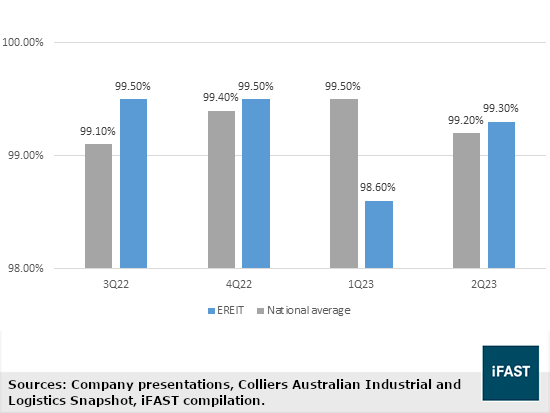
Additionally, portfolio occupancy rate for the Singapore portfolio outperforms the industrial average consistently (Chart 1). The Australia portfolio occupancy rate also outperforms the national average, with the exception of 1Q23 where portfolio occupancy was at 98.6%, below the average of 99.5% (Chart 2).
Chart 1
EREIT’s
Singapore Portfolio Occupancy rate against Industrial Average Rates
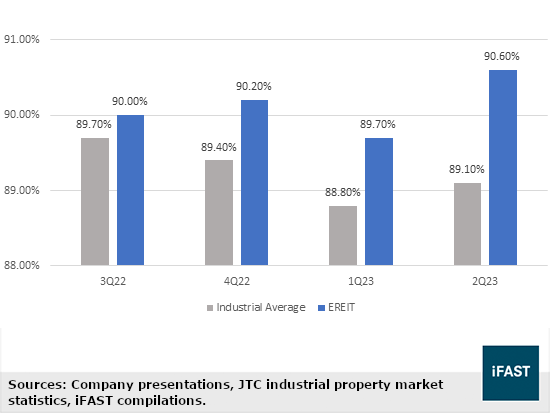
Chart 2
EREIT’s
Australian Portfolio Occupancy rate against National Average Rates
Decent debt and credit profile
Chart 3
Debt
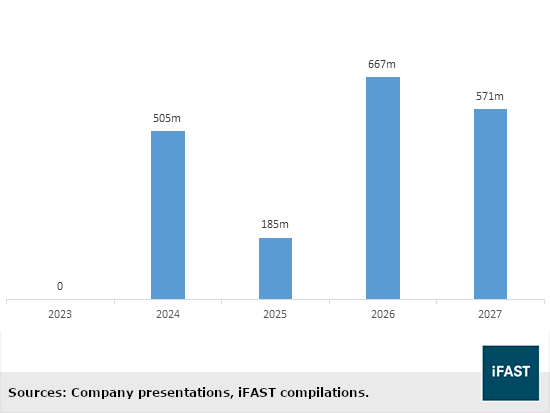
Maturity Profile as of 30 June 2023
EREIT
has a total debt of SGD1,927m as of 30 June 2023, and boasts a well staggered
debt expiry profile as shown in Chart 3. There is no refinancing risk as all
debt expiring in FY23 has already been refinanced. EREIT will have sufficient
time to look for refinancing measures for the large proportion of its debt due
in the later years of 2026 and 2027.
EREIT’s long-term credit profile also looks solid, reporting an interest rate coverage ratio (“ICR”) of 3.2x in 1H23, with an adjusted ICR (including perpetual securities) of 2.5x. This is a slight fall from the figures of 3.5x and 2.8x respectively reported in 2H22 ended 31 December 2022, largely due to the increase in interest costs. Despite the current high interest rate environment, weighted average all-in cost of debt was recorded at 3.96% p.a. as of 30 June 2023, only a slight increase from 3.66% as of 31 December 2022, helped by the fact that most of the interest rates on its debt (74.8%) have been fixed for 1.7 years.
Gearing ratio post-equity fund raising was 39.4% as of 30 June 2023, below the MAS regulatory limit of 45%. Gearing ratio would further decrease to 33.6% should the proceeds from the proposed SGD337.0M divestment of 7 non-core assets from the portfolio be used to repay existing debt. Debt headroom based on 45% gearing limit was at SGD 513.7m as of 30 June 2023, allowing EREIT some leeway to expand and acquire new assets in the future where interest rates may be lower and more stable.
EREIT has been increasing its cash reserves through various measures. An example would be the recent equity fund raising of approximately SGD 300.0m, as well as the disposal of non-core assets. They have also adopted a more conservative approach towards acquisition spending – with no spending on acquisition of properties, investments or subsidiaries in 1H23 – a stark contrast to the spending we observed in the previous financial years.
Recently, EREIT has put more emphasis into divesting its non-core assets to raise cash, with SGD361.4M worth of properties being allocated for divestment in 1H23. This figure is more than six times the value of properties held for divestment in 2H22. Having more cash on hand would have the added benefit of allowing EREIT to make smart purchases when opportunities present themselves.
Table 1
EREIT’s acquisition and
divestment-related cash flows (in SGD thousands)
|
Period |
1H23 |
2H22 |
1H22 |
2H21 |
1H21 |
|
Cash and cash equivalents at end of period |
46,612 |
42,949 |
44,194 |
24,150 |
13,982 |
|
Proceeds from disposal of investment properties |
43,500 |
87,862 |
23,100 |
52,760 |
- |
|
Costs relating to acquisition of investment properties/ subsidiaries/ investments |
- |
167,517 |
106,857 |
1,879 |
187,392 |
|
Investment properties held under divestment |
361,410 |
56,595 |
51,876 |
29,264 |
61,025 |
|
Sources: Company financial statements, iFAST Compilations. |
|||||
Resilient demand for EREIT’s portfolio assets in core markets of Singapore and Australia
EREIT has a broad base of 436 tenants in various sectors such as manufacturing, e-commerce, electronics etc. No single tenant accounts for more than 5.4% of effective gross rent as of June 2023, which translates to minimal impact on rent revenue should any existing tenants choose not to renew their leases.
EREIT has been rebalancing its portfolio to shift from dated assets (short underlying land lease, small size and limited redevelopment potential) to New Economy assets (logistics and high-specs properties) to put them in prime position to capitalize on future growth opportunities – afforded by the emergence of third-party logistics players (3PL), e-commerce and advanced manufacturing. As of 30 June 2023, 63.2% of EREIT’s portfolio consists of New Economy (logistics and high-tech assets) based on rental income, with 7 high specs and 18 prime logistics assets in Singapore, 20 logistics properties in Australia and 1 logistics asset in Japan.
The popularity and growth of New Economy sectors translates to strong demand for modern and high-specifications properties as they meet business requirements and sustainability targets of tenants operating in such industries. Hence, with EREIT’s portfolio containing many of such properties, they are in prime position to take advantage of these growth opportunities through positive rental reversions and higher occupancy rates to increase net property income (NPI).
According to studies by Cushman and Wakefield on Singapore’s industrial sector performance for 2Q23, most industrial property segments saw positive rental growth QoQ in both quarters of 2023, with the exception of factory buildings which saw no rental increases in both periods and business parks in outlying areas which saw rental prices decrease by 0.5% QoQ in 2Q23. More details can be found in the table below:
Table 2
1Q23 and 2Q23 rental increases by
property segment
|
Property Segment |
Rental increase in 1Q23 (QoQ) |
Rental increase in 2Q23 (QoQ) |
|
Business Park (City Fringe) |
0.4% |
0.4% |
|
Business Park (Outlying areas) |
0.2% |
-0.5% |
|
High Specs |
1.2% |
0.3% |
|
Prime logistics |
7.5% |
2.2% |
|
Warehouses |
3.1% |
0.0% |
|
Factories |
0.0% |
0.0% |
|
Sources: Cushman and Wakefield Industrial Marketbeat Reports, iFAST Compilations. |
||
While EREIT has three business parks in its Singapore asset holdings which are all classified as being in outlying areas, they only contribute 17.9% of EREIT’s rental income, lessening the impact of the declining rents for this property segment on NPI. The report also states that conventional general industrial properties are likely to see slow rental growth due to manufacturing slowdowns and high supply, affirming EREIT’s approach of divesting properties with dated specs and low remaining land lease to allow for more debt headroom to acquire New Economy assets.
Furthermore, EREIT’s Singapore portfolio passing rents are all below market rates, signaling potential for positive rental reversions when renewing upcoming lease expiries, adding a further boost to NPI. Even amidst challenging headwinds and weak economic outlook for the Singapore industrial sector, EREIT is well-positioned to cater to the evolving market and achieve further expansion.
As for the Australian market, the industrial and logistics sector has continued its strength into 2Q23, with over 930,000 square meters leased. While supply for industrial and logistics building in 2023 is expected to be at a record high of about 3.1 million square meters, demand is still expected to overwhelm supply in the near term, helping to drive continued rental growth and the formation of a stable tenant base. The forecasted rental growth for FY2024 in Brisbane and Melbourne, areas in which EREIT holds 19 of its 20 Australian logistics assets, is 6.0% and 4.0% respectively. While rental uplift is expected to be persistent, the uptake of leasing in 1H23 has fallen by 37.0% YoY in view of low expected consumer spending fueled by recessionary fears. Regardless, EREIT’s Australia portfolio is expected to continue thriving in an Australian market, shaped by an undersupply of industrial space in the short-medium term.
With measures such as the equity fund raising completed in April 2023, EREIT has funding and leeway for future acquisitions to further expand its portfolio. Overall, EREIT has growth prospects that may be attractive to investors, particularly in the New Economy segment.
Recommendations
Table 3
Fixed
rate issuances by similar S-REITs
|
Bond |
Ask Price |
Yield to Maturity |
Option adjusted spread (bps) |
Years to maturity |
Bond Credit Rating |
|
96.26 |
4.25% |
94.3 |
3.24 |
Unrated |
|
|
99.17 |
4.36% |
111.0 |
3.66 |
Unrated |
|
|
98.92 |
3.93% |
29.7 |
1.49 |
A3 (Moody’s) |
|
|
99.95 |
3.81% |
38.1 |
2.49 |
BBB+ (Fitch) |
|
|
92.00 |
5.62% |
226.5 |
2.91 |
Unrated |
|
|
Sources: Bloomberg Finance L.P., Bondsupermart, iFAST Compilations. Data as of 6 September 2023. |
|||||
Table 4
Peer Issuers
|
Issuer |
Adjusted ICR |
Gearing Ratio |
Cash Ratio |
|
KITSP |
2.3x |
38.5% |
0.41x |
|
AREIT |
4.1x |
36.7% |
0.17x |
|
MINTSP* |
4.4x |
37.4% |
0.43x |
|
EREIT |
2.5x |
39.4% /33.6% (after divestment completion) |
0.11x |
|
Sources: Bloomberg Finance L.P., Company Financial Statements, iFAST Compilations. Note: Based on 1H23 results with the exception of MINTSP *Information from 1QFY23/24, period ending 30 June 2023 |
|||
We recommend the EREIT 2.600% 04Aug2026 Corp, for its short tenor of 2.9 years and relatively attractive yield to maturity of 5.62% (as of 6 September 2023). Looking at the tables above, we compare to several bonds with similar years to maturity in the logistics/ industrial property REIT space.
MINTSP and AREIT are both REITs in the same sector (industrial and logistics buildings) and have credit and liquidity profiles that are more solid, but offer a much lower spread. KITSP on the other hand, has a portfolio that is mainly focused on the sector of Energy Transition (60%), different from EREIT, but has similar credit and liquidity metrics (similar ICR and similar gearing). The two comparable KITSP bonds offer higher yields than their MINTSP and AREIT counterparts, but still pales in comparison to the yield of the EREIT 2.600% 04Aug2026 Corp.
Investors with a higher risk appetite looking within the industrial S-REITs can consider EREIT, as compared to MINTSP and AREIT which has a better credit profile, but lower yield pick-ups. We believe that there is plenty of room for EREIT to continue expanding with the recent dominance of the New Economy sectors. Coupled with the current high interest rate environment that may persist for the foreseeable future, EREIT’s current approach of selling non-core assets while waiting for acquisition opportunities seems like the correct play.
Declaration: For specific disclosure, at the time of publication of this report, IFPL (via its connected and associated entities) and the analyst who produced this report holds a NIL position in the abovementioned securities.
Our podcast series, Yield Hunters, is available on Spotify, iTunes Podcasts and Google Podcasts. We share our thoughts on new bond issues and hold discussions on the fixed income space. Listen to our latest episode below and follow us!